

The Convergence Stack: Why AI, Quantum Computing, and Tokenization are one machine

While the world is justifiably captivated by the generative AI boom, a quieter, more profound shift is happening beneath the surface.
Most professionals view Artificial Intelligence, Quantum Computing, and Blockchain Tokenization as separate technological silos. Investors chase “AI stocks,” futurists debate “Quantum timelines,” and financial giants like BlackRock prepare for a “Tokenized future.”
But if you zoom out, you realize these aren’t separate trends. They are three distinct organs of a single future operating system for the global economy.
To understand where we are headed by 2026 and beyond, we need a new mental model. I call it the “Convergence Stack.”
Here is how these three powerful forces fit together into a cohesive machine.
The Problem with Silos
We currently have a major bottleneck in innovation: Friction.
We have incredible AI models that can define complex problems. We have emerging Quantum systems that will soon solve those problems in seconds. But our economic rails, the way we record value, establish ownership, and move capital, are stuck in the 20th century.
A Quantum discovery happens in minutes, the resulting patent filings, capital raising, and market settlement take months.
The future requires the value to move as fast as the information.
The New Mental Model: Brain, Muscle, and Ledger
If we view these technologies not as competitors, but as complementary layers of a stack, the picture becomes clear.
Classical Computers are binary (black or white).
Quantum Computers are probabilistic (shades of gray).
AI is the translator between us and them.
Tokenization provides the economic truth that anchors the system.
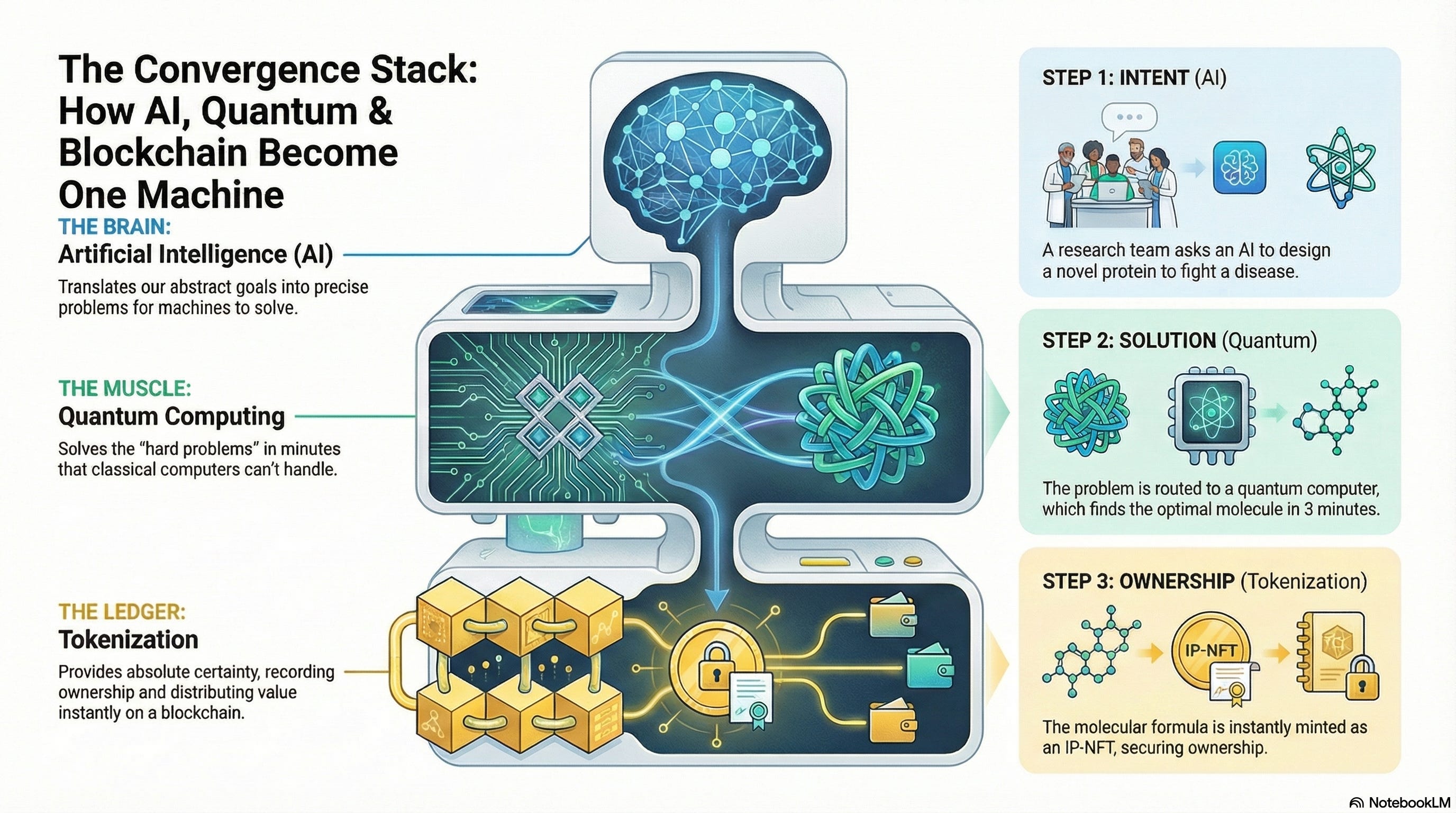
Here is the breakdown of the Convergence Stack:
1. The Brain: Artificial Intelligence (AI)
Role: The Architect & Interface AI bridges the gap between human intent and machine execution. Humans are terrible at describing complex problems in mathematical terms. AI translates our fuzzy, abstract goals (”Find a protein structure to neutralize Virus X”) into the precise language the computational layer needs. It defines what to solve.
2. The Muscle: Quantum Computing
Role: The Builder & Calculator AI can define the problem, but it often hits a computational wall with classical binary systems. Simulating molecular structures or optimizing global logistics requires exploring billions of possibilities simultaneously. This is where Quantum steps in, utilizing superposition to solve the “hard problems” in minutes that would take classical supercomputers millennia. It solves how to do it.
3. The Ledger: Tokenization
Role: The Notary & Bank This is the missing link that most technologists underestimate. In a quantum world defined by probabilistic outcomes and AI hallucinations, the economic layer needs absolute, binary certainty.
Tokenization is that certainty. It is the “operating system” that BlackRock CEO Larry Fink is betting on. It captures the output of the Quantum/AI layers, records the intellectual property as a unique digital asset on a blockchain, fractionalizes the ownership, and handles the immediate distribution of value (royalties or dividends).
It determines who owns the result and gets paid.
The Stack in Action: A Scenario
To visualize this, let’s imagine a near-future scenario in drug discovery:
The Intent (AI): A research team tells an AI agent to design a novel protein to target a specific disease marker. The AI defines the massive computational parameters required for the simulation.
The Solution (Quantum): The AI routes this “hard problem” to a Quantum utility provider. The quantum processor simulates millions of protein folding combinations and returns the optimal molecular structure in 3 minutes.
The Ownership (Tokenization): This is the crucial pivot. Instead of a 6-month legal process to file patents, the specific molecular formula is instantly minted as an IP-NFT on a secure blockchain.
The Singularity of Finance
We are not just heading toward an “AI future.” We are heading toward a convergence where AI directs quantum power to solve immense problems, and blockchain rails instantly manage the resulting immense value.
The technology is complex, but the mental model is simple: Intent (AI) → Solution (Quantum) → Ownership (Tokenization).
This piece really made me think, and I deeply resonate with your point that AI, Quantum, and Tokenization aren't separate silos but organs of a single future operating system, which is such a powerful insight for someone passionate about AI like me. Your 'Convergence Stack' and the Brain, Muscle, Ledger anology are brilliant mental models that make perfect sense, especially how you highlight the need for value to move as fast as information to overcome current innovation friction.